
How AI-generated incident imagery is evolving – and why intelligence-led verification matters
AI-generated images of road traffic collisions are appearing online, often from accounts with no apparent local connection. NetWatch looks at how convincing these scenes can be, the inconsistencies that give them away, and why checking the evidence behind an image still matters.

Jess Allen
Analyst Manager
AI-generated imagery is a growing challenge
Artificial intelligence (AI) is rapidly changing the digital information environment. From stylised images and workplace caricatures to increasingly convincing synthetic photographs, AI-generated content is becoming a familiar part of everyday life.
However, its implications extend beyond novelty. NetWatch has identified an emerging, alarming trend involving AI-generated images purporting to depict real road traffic collisions. Often shared by accounts with no apparent local connection, these images raise questions not just about authenticity, but also about the evolving tactics used to attract engagement and manipulate online information environments.
For organisations that rely on timely, accurate information to understand developing events, the circulation of fabricated incident imagery presents a wider challenge – distinguishing genuine intelligence from misleading content in an increasingly complex digital environment.
Putting generative AI to the test
In the past, our analysts have observed comments on the social media pages of major news outlets which enticed users with comments such as "I have tragic footage of the incident, have a look" with a risky link – with the aim of enticing users to click the link and load malware or similar onto their devices. Users have become aware of these and such comments are now often automatically blocked.
As platforms become better at identifying and blocking suspicious links, those seeking to attract engagement or manipulate online conversations may turn to other tactics. AI-generated imagery is one emerging pattern that warrants closer scrutiny.
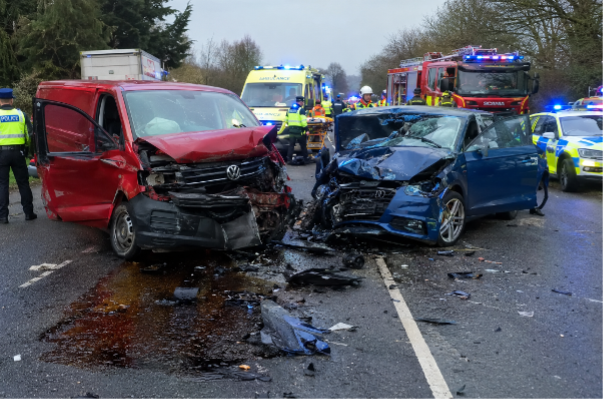
In one recent instance, an analyst uncovered a 'photograph' purported to be of the scene of a fatal road traffic incident on a rural road. The makes, models and colours of the vehicles involved were completely accurate, with many emergency services seen in the background of the image. However, we uncovered that this was AI.
To demonstrate how easily such imagery can be produced, we generated a fictional collision scene using a standard free-to-use AI chatbot. The following example does not depict a real incident. The following prompt was given:
I want you to make me a realistic photograph depicting the aftermath of a serious road traffic accident.
The vehicles involved are:
A red Volkswagen Transporter T6
A blue Audi A1
They have had a head on collision and there is lots of debris on the road plus oil leaking from the T6. Police, ambulances and a fire engine are on the scene.
It produced the below image.
Beyond the image: identifying inconsistencies
On first glance, the image would be convincing – but there are some aspects of it which may trigger alarm bells surrounding inconsistency and help to paint an overall picture.
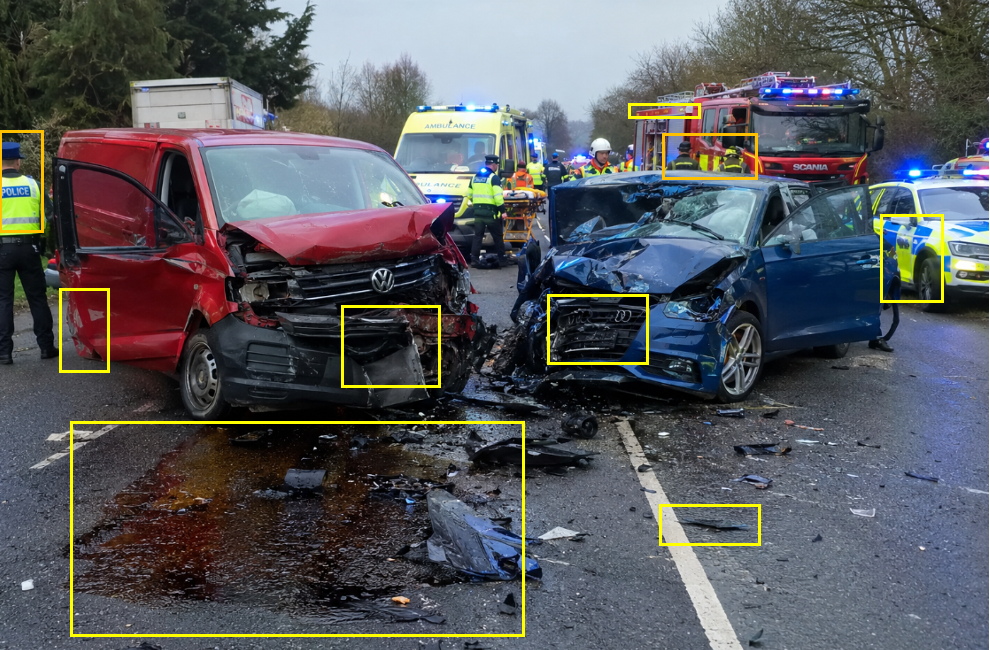
Firstly, the prompt advised of a head-on collision and while there is damage to the front of both vehicles, they both conveniently face the 'camera' – something we have seen in other examples of AI-generated imagery found on social media. That said, this on its own is not a clear indicator of a false image.
Secondly, a police officer on the left of the image can be seen wearing a hat which is not standard-issue in the UK and bears more resemblance to a French police hat (kepi). Similarly, the majority of UK-based fire and rescue services have moved away from black or dark blue fire kit to gold, tan or light-coloured fabrics – but the image above shows fire crew in dark kit, which may present a discrepancy to delve into further. Additionally, one of the firefighters is not wearing a clearly visible helmet, but a bowler hat.
Furthermore, closer inspection reveals several more inconsistencies in the image. For instance, there is a clump of red metal where you may expect the rear wheel of the van to be. Neither vehicle can be seen displaying a vehicle registration plate at the front, and there is no evidence of these having been damaged or falling from either vehicle. The oil spill from the van seems widespread and again towards the 'camera' rather than in any other direction. Some debris looks like it's floating and casts a shadow, when the weather in the image seems overcast. There is no emergency service branding on any such vehicle, especially where you may expect to see it. While none of these independently establishes that an image is AI-generated, considered together they provide reasons to question authenticity.
Detection is only the starting point
As we have identified, while the image can be convincing, the number of inconsistencies warrant further investigation as to whether an image is AI-generated.
As such, as is standard in intelligence analysis, NetWatch takes great care to validate and corroborate information such as this to establish its reliability and validity. This includes scrutinising images and not taking anything at face value.
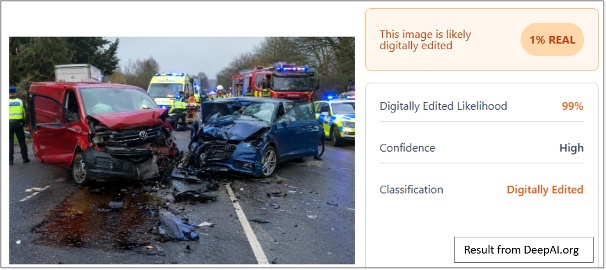
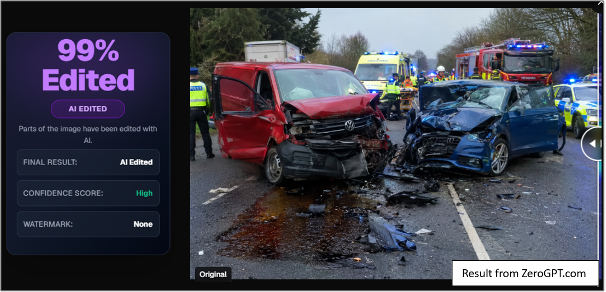
In addition to scrutinising the image itself, analysts can use AI image detection tools and digital provenance checks to look for further indicators of manipulation or AI generation. Depending on the tool, these may include analysing patterns within the image, checking for embedded watermarks or examining available metadata and digital credentials. However, these results should be treated as supporting evidence rather than definitive proof, as detection tools can produce both false positives and false negatives. In our case study, multiple detection tools flagged the image as likely to have been digitally generated or edited with high confidence.
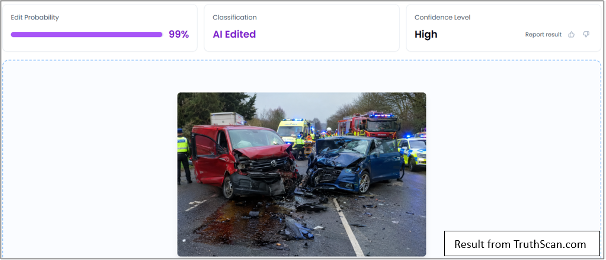
Practical advice for case handlers
Our top five tips for being mindful of AI-generated imagery, particularly when capturing or reporting incidents, are:
- Don't assume an image is genuine just because it looks realistic. Just because something looks real, doesn't mean it is. AI technology is continually advancing, making generated images increasingly convincing and harder to distinguish from genuine photographs.
- Check the account that posted it. Does the account appear genuine? Was it recently created? Does it have an established history and a local connection? Has the image been shared by any reputable news outlets or verified local sources? Is a photographer credited, and can that person or their work be verified?
- Be mindful of the little details. Does anything about the image seem out of place? Does the debris appear consistent with the damage to the vehicles? Do emergency service uniforms and vehicle markings bear a resemblance to those used by local authorities? Are any number plates and other vehicle details plausible? Does any text in the images look correct?
- Look at the bigger picture. Does the road layout and surrounding topography match the reported location? Do the weather, lighting and other surroundings make sense? Are emergency service personnel responding to the incident in a plausible way, or does something about their positioning or interaction with the scene seem unusual?
- Seek to corroborate. Use reverse-image searches to check whether the image has appeared previously or been shared elsewhere. AI image detectors and available metadata or digital provenance checks may provide additional clues, but their results are not conclusive. No single tool can reliably confirm whether every image is genuine or AI-generated.
Verification, verification, verification
As AI-generated imagery becomes increasingly convincing, distinguishing fabricated scenes from genuine photographs will become more challenging for everyone. While visual inconsistencies and detection tools can offer useful clues, neither should be relied upon in isolation.
For NetWatch, the key is to approach all online imagery with a critical eye, assess its reliability and seek independent corroboration before drawing conclusions. The same principle applies to anyone encountering a seemingly genuine image on social media.
A photograph or video can look convincing without being authentic, and considering it as valuable intelligence without verification can result in misinformed or incorrect conclusions and recommendations – potentially wasting case handler time on a red herring.
When it comes to online imagery, NetWatch don't just look at the picture. We look for the evidence behind it.